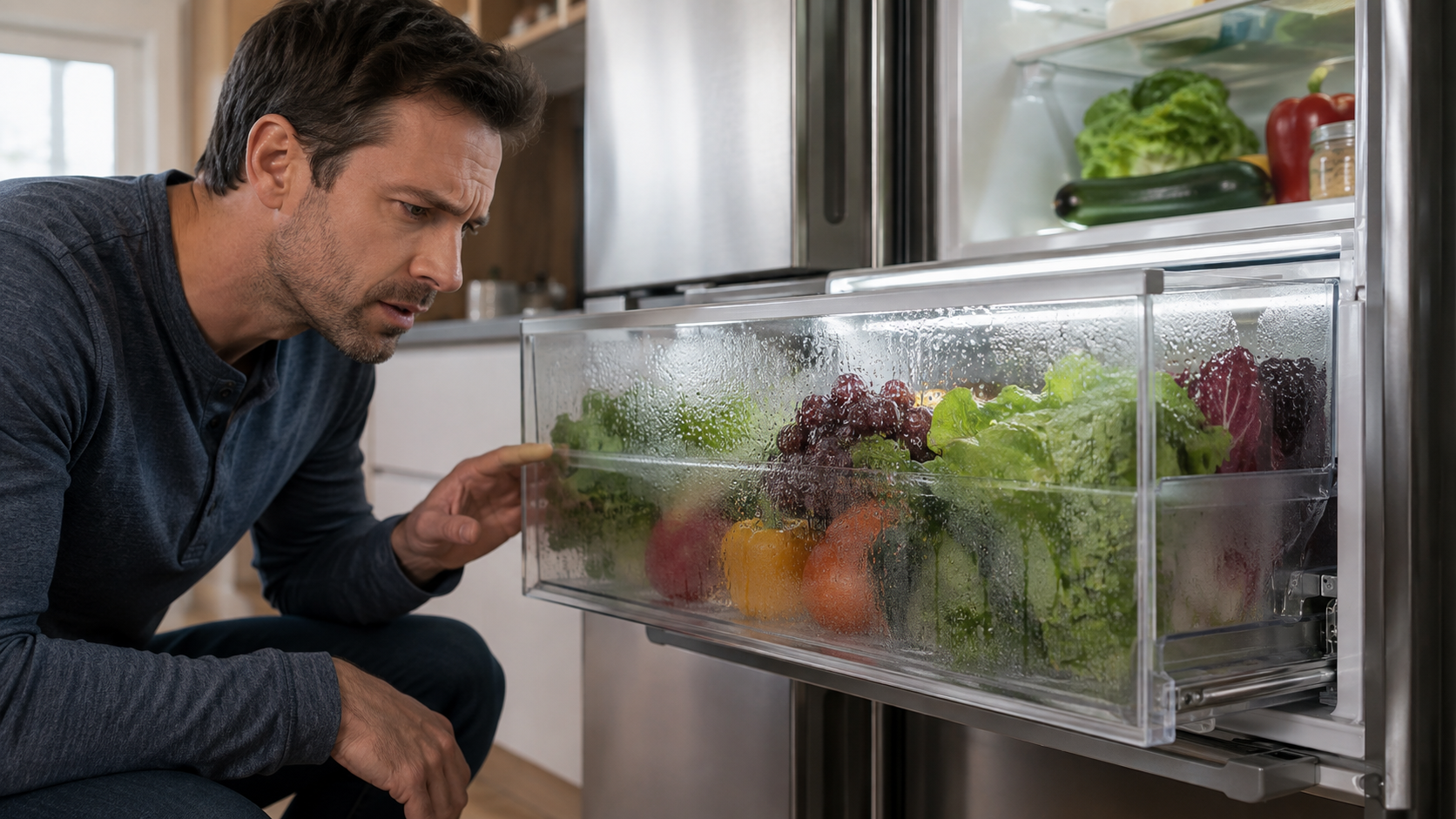
BioFresh is designed as a near-0°C freshness zone with humidity behavior that differs from the main refrigerator compartment. If BioFresh is too warm, first determine whether only the drawers are affected or the whole refrigerator has an airflow/cooling…
BioFresh is designed as a near-0°C freshness zone with humidity behavior that differs from the main refrigerator compartment. If BioFresh is too warm, first determine whether only the drawers are affected or the whole refrigerator has an airflow/cooling problem.
A good diagnosis starts by proving what the appliance is actually doing before any reset or component replacement. When troubleshooting a Liebherr BioFresh zone that is too warm, verify the observable condition first and then narrow the fault path. That keeps a temporary load, door event, or setup issue from being mistaken for a failed component—and it also keeps a real intermittent problem from being hidden by repeated resets.
Liebherr notes that BioFresh temperature can be adjusted on applicable models. An altered setting can move the drawer away from its normal near-0°C range.
Packed shelves, iced air paths, or fan problems can reduce cold-air delivery to the drawers.
BioFresh cannot maintain its intended zone if the upstream cooling system is already struggling.
A BioFresh or compartment sensor can cause the zone to regulate incorrectly.
A drawer not fully closed or internal parts not seated correctly can change the intended microclimate.
These checks for a Liebherr BioFresh zone that is too warm are deliberately low-risk and are meant to narrow the diagnosis, not to bypass safety devices.
Do not call the issue resolved until the appliance has had enough normal operating time to show that the symptom is gone rather than temporarily hidden. This matters specifically for a Liebherr BioFresh zone that is too warm.
One community repair case described a Liebherr refrigerator where BioFresh drawers were reportedly cool while the upper shelf was around 55°F and icing was present near the rear. That inverse pattern is useful: BioFresh can help reveal whether the failure is compartment-specific airflow rather than a total loss of refrigeration.
Community evidence is useful as a clue, never as a universal parts diagnosis. With a Liebherr BioFresh zone that is too warm, two Liebherr models can present a similar complaint for different reasons.
| Pattern | What it can mean | Best next check |
|---|---|---|
| BioFresh setting changed | Liebherr notes that BioFresh temperature can be adjusted on applicable models. | Measure BioFresh separately from the upper refrigerator shelves. |
| Airflow to the BioFresh zone is restricted | Packed shelves, iced air paths, or fan problems can reduce cold-air delivery to the drawers. | Check the BioFresh temperature adjustment in the model instructions before changing the main refrigerator setpoint. |
| Main refrigerator cooling is weak | BioFresh cannot maintain its intended zone if the upstream cooling system is already struggling. | Make sure drawers close fully and air paths are not blocked. |
| Sensor or control issue | A BioFresh or compartment sensor can cause the zone to regulate incorrectly. | Compare the symptom with the rest of the cabinet: BioFresh warm + upper shelf warm points differently from BioFresh warm alone. |
Use this table to triage a Liebherr BioFresh zone that is too warm, not as a parts list. If more than one row fits, correct the obvious operating condition first and then reassess the original symptom after the appliance stabilizes.
If resolving a Liebherr BioFresh zone that is too warm would require live-voltage measurements, internal control-board access, refrigerant work, or disassembly beyond the owner instructions, stop at the observation stage and move to model-specific service.
Arrange service rather than continuing trial-and-error if any of the following applies to a Liebherr BioFresh zone that is too warm:
These conditions move a Liebherr BioFresh zone that is too warm beyond routine owner checks and into component diagnosis.
For a Liebherr BioFresh zone that is too warm, the strongest service request includes evidence: the exact model, when the symptom starts, what the display shows, an independent temperature reading where relevant, and any door, power, water, or noise event that happens at the same time.
CTA: Schedule Service · Call (305) 555-0142
Liebherr describes BioFresh as operating close to 0°C, with humidity adjusted for different foods. Use your model instructions for the exact adjustment range.
That pattern can point to airflow distribution or compartment-specific sensing rather than a complete cooling failure.
Check the BioFresh-specific adjustment first on models that provide it. Changing the main compartment may create new problems elsewhere.
No. It is a controlled freshness zone with different temperature/humidity behavior, so it should be diagnosed as its own subsystem.
A beeping Liebherr wine refrigerator is usually trying to report a door or temperature condition, not merely making an unexplained sound. The…
Wine storage is especially sensitive to repeated temperature movement. A short change after the door opens is normal; a Liebherr wine fridge…
A Liebherr wine refrigerator must do more than feel cool: it must hold the selected zone temperature consistently without excessive heat, vibration,…
Share a few details and we’ll confirm an appointment. Prefer to talk? Call us and we’ll help right away.
Fill in the form below and we’ll confirm an appointment.